|
Annan, Dumfriesshire,
Scotland
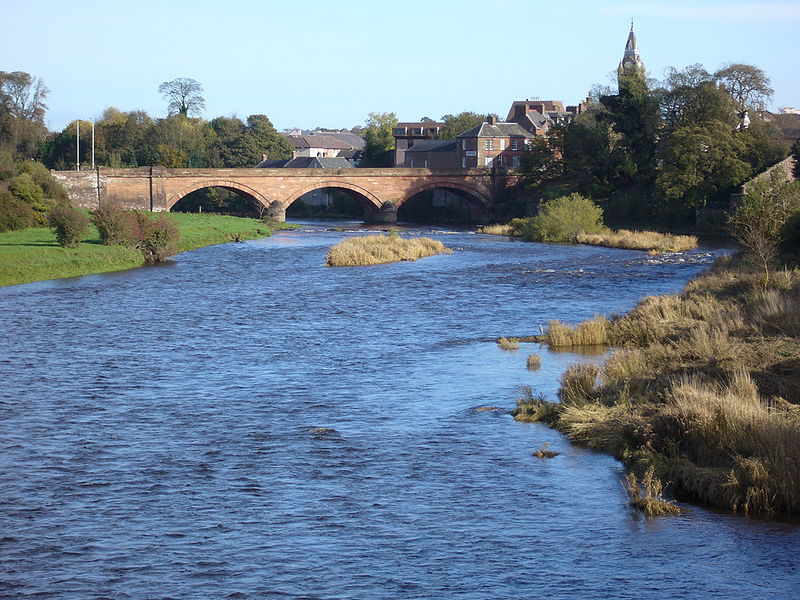
River Annan road bridge in Annan
Click on the following links for
more information about Annan:
History of Annan
More History of Annan
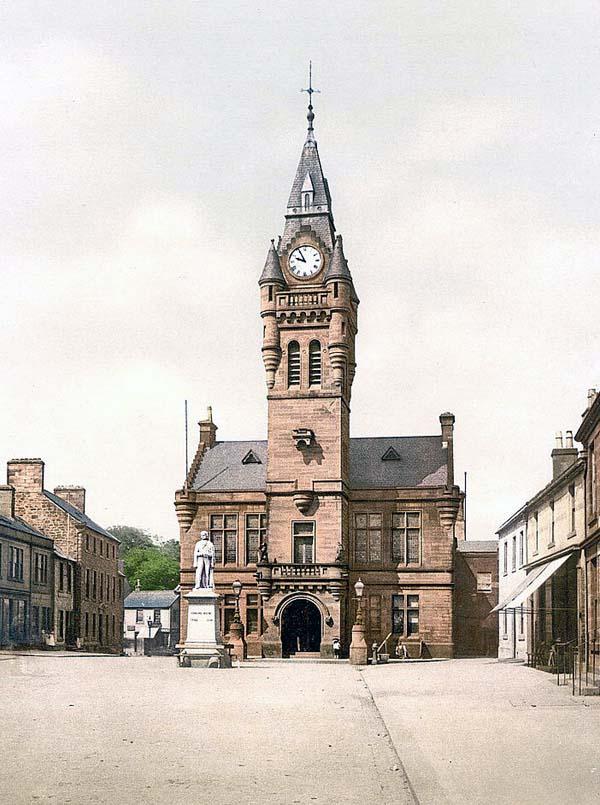
Annan Town Hall
Other Annan Photos
Fortresses and
Castles of Annandale
The following information is
taken from a
website page created by Sandy Stevenson. Her related
website is called "Welcome to My Scotland." These websites
describe many historical sites in the Annandale area, in and around
which many of the Patersons lived.
* *
*
Remote lochs glitter amongst the
gentle hills of Annandale and Eskdale, south of which lie the fiat
Solway marshes, where sea birds gather on a huge nature reserve. The
turbulent history of the borderlands haunts this stretch of
countryside. Fortresses and castles stand in ruins after endless
raids, and the memory of Robert Bruce -- hero king of Scotland --
lingers on in the places he visited.
Annan
Victorian red-brick houses over-look banks
of River Annan, where anglers try for salmon and trout. Dismantled
railway, now over-grown, once led to bridge across Solway Firth.
Locally born historian, Thomas Carlyle, taught at Annan Academy in
the 19th century.
Barr's Hill
Network of ditches and huge bank remain
from Iron Age hill-fort, built on narrow ridge between Annandale and
Nithsdale.
Beattock Hill
Narrow road leads to top of Beattock Hill.
Iron Age fort lies near summit, with extensive views over Annandale.
In days of steam, trains laboured to climb dramatic 10 mile incline
of Beattock Bank.
Bruce's Cave
Steep footpath leads to cave above Kirtle
Water where, according to legend, Robert Bruce hid from the English
invaders in 1306 and, inspired by a spider trying again and again to
spin its web, carried on his struggle for independence.
Burnswark
Iron Age defences extend 17 acres on
windswept hilltop, looking out to Solway Firth and Cumbrian coast.
Remains of two Roman siege camps on opposite hillside date from AD
155, and small Roman fort dates from AD 140.
Caerlaverock Castle
Triangular fortress on shore of Solway
Firth has mysterious origins. Built during 1290s, but whether by
English or Scots is unknown. Largely destroyed 1320, rebuilt a few
years later and demolished again by Scots in 1357. Pink-sandstone
gatehouse survives from castle rebuilt 15th century, reduced to
ruins in 1640. Finely carved panels remain from mansion added to
building in 1630s by Robert Maxwell, 1st Earl of Nithsdale.
Caerlaverock Nature
Reserve
Barnacle geese from Spitzbergen and large
flocks of pink-footed and greylag geese make this 13,000 acre area
of salt marsh and foreshore a notable bird sanctuary. Wild ducks and
waders haunt creeks and reed banks. Hides and observation towers.
Comlongon Castle
Well-preserved Great Hall, dungeons and
fine bedrooms create medieval atmosphere in 15th-century castle on
Scottish border. Picnic area and nature trail in surrounding
woodland.
Craigcleuch
Scottish Baronial mansion, 19th-century,
houses Craigcleuch collection of curiosities found by early Scottish
explorers, including carved coral and ivory, African sculptures,
Chinese jade animals, prehistoric ornaments and implements. Set in
parkland overlooking Esk valley, with views north between 'Gates of
Eden' hills.
Devil's Beef Tub
River Annan flows down this 500ft deep
hollow among four barrett hills which look, according to Sir Walter
Scott in his novel Red-gauntlet, 'as if they were laying their heads
together to shut out the daylight from the dark hollow space between
them'.
Dryhope Tower
Ruins of stout 16th-century tower stand by
northern shores of St Mar/s loch. Once home of Mary Scott, ancestor
of Sir Walter Scott.
Ecclefechan
Historian Thomas Carlyle born 1795in
'Arched House' built by his father and uncle, master masons.
Restored as in his day, containing papers and personal belongings.
Ewes
Hamlet lying at foot of Eskdale hills. A
300-year-old bell hangs in churchyard tree; put there for safety
when old church was demolished, stayed when the new church was built
1867. Fine views of Ewes Water and Teviotdale.
Forest of Ae
Road and waymarked walks wind through
woods and hills thick with grass or bracken, some-times under trees
bent over to meet one another. Picnic site beside stream fringed by
spruce and alder.
Gretna Green
Village close to the border with England
where runaway couples could seek quick marriages under easygoing
Scottish law at the old tollhouse or smithy, until the custom was
banned in 1940. Old Blacksmith's Shop, where wed-dings were
performed by an 'anvil priest', now a museum.
Grey Mare's Tail
Path leads to foot of this spectacular
200ft waterfall formed by Tail Burn dropping from Loch Skene to join
Moffat Water. Area rich in wild flowers has herd of wild goats.
Hoddom Castle
Sturdy 16th-century watchtower built by
John Maxwell stands on hill above site of 16th-century tower castle.
Visitor centre is start of riverside and woodland walks.
Langholm
Thriving mills surround this textile
centre where River Esk meets Wanchope Water and Ewes Water; spanned
by several bridges. Narrow, twisting streets of old part contrast
with 18th-century houses of 'new' town across river. Ruined peel
tower was home to the Armstrong family, ancestors of astronaut Neil
Armstrong -- first man on the moon.
Lochmaben
Nature reserve surrounds the creeper-clad
ruins of a 14th-century castle, reputed birthplace of Robert Bruce.
Both James IV and Mary, Queen of Scots visited castle. Look for
greylag and pink-footed geese in Castle and High-tae lochs. Statue
near the town hail recalls local man William Paterson, co-founder of
Bank of England in 1694.
Megget
Picturesque valley transformed in 1983 by
reservoir, stocked with trout. Picnic areas with good viewpoints.
Visitors can walk along top of dam.
Moffat
Sheep-farming centre, symbolized by ram
statue in high street. Spring discovered 1633 made it popular spa.
Robert Burns among those who came to take waters. Baths Hall of 1827
now town hall. Local crafts thrive at woollen mill.
Powfoot
Resort created late 1700s at mouth of Pow
Water. Sand yachting on beach. Golf course. Kinmount gardens with
lakeside walks and resident geese.
Rammerscales
Manor with Palladian frontage built 1760
for Dr James Mounsey, physician to Tsarina Elizabeth of Russia.
Annandale views, picnic site, woodland walks and garden.
Ruthwell
Church has late 7th-century cross, 18ft
high, carved with figures and runic verses from Anglo-Saxon poem The
Dream of the Rood; possibly written by Caedmon, a 7th-century monk
and poet from Whitby in Yorkshire. Small museum commemorates Henry
Duncan in cottage where he founded Scottish Savings Bank. Displays
include bank archives p.' and room settings of late 18th and early
19th centuries.
St Mary's Loch
Sailing and angling centre. Statue of
local poet James Hogg (1770-1835) stands above Tibbie Shiels Inn.
Single-track road to beauty spot of Talla Reservoir.
St Mungo's Church
Shell of church lies above River Annan.
Mungo was 6th-century 'Apostle of Strathclyde' who became Glasgow's
patron saint.
Telford Memorial
Recalls engineer Thomas Telford, born
1757. As an apprentice he , worked on the bridge at nearby Langholm.
Teviothead
Hamlet with a churchyard memorial marking
mass grave of border outlaw Johnnie Armstrong and 36 of his men,
sent to gallows with-out trial by James V, 1530.
Torthorwald Castle
This 15th-century fortress of the
Kirkpatricks and later Carlyles is an unsafe ruin. View it from
road.
Tweedsmuir
Good walking country where Talla Water
meets Tweed. Church built in 1874 has war memorial from oak tree
planted 100 years earlier by writer Sic Walter Scott. Covenantor's
stone of 1685 lies in the churchyard.
|